
02 Dec Critical Colours: Analysing and Exhibiting Archive Materials and Museum Collections
Online Seminar (Zoom): 2pm – 4.40pm (UK) Wednesday 2nd December 2026
Attendance (free, but please register via Eventbrite):

Convened by Dr Liz Watkins for the Colour Group (GB). Contact: liz.i.watkins@gmail.com.
All welcome.
This interdisciplinary seminar focuses on the theories and methods that have informed the design and use of digital analytical tools and databases to further understanding and access to museum collections and archives of colour materials (photographs, film stocks, pigments, paints, dyes, textiles). We will discuss the ways digital analyses and critical methods (colourisation, editing, the organisation of databases, curation, film making and art practices) might ethically offer new perspectives on the systems of knowledge that remain in archives of colour materials as traces of the industries and labour that produced them.
The seminar brings together scholars, archivists, imaging scientists, curators and artists to discuss the diverse ways that the systems of knowledge that are embedded in the ideology specific to each filmstock (Gunning), exhibition, database, digital and other analytical tools can replicate or diverge from the epistemological forms of colour charts, artists’ palettes, indexes and organisational forms of historic colour collections. If colour (susceptible to fading, discolour, imbalances) is critical to questions of preservation, then can colour also act as a critical tool able, through curatorial and art practices, to query the ideologies encoded (gender, ethnicity, race) in colour systems?
These lines of enquiry will be integral to our discussion as we revisit the history of colour materials (trade routes, industrial labour) that intersect with the politics of representation:
- How have colour materials been selected, organised and curated into digital collections and exhibitions? Or begun to engage viewers in the social, ideological and political histories of colour materials?
- What insights have emerged through analyses of the physical substances of colour photographs (Autochromes, tints, tones), films (dye imbibition, chromogenic film stocks), paintings (pigments, artists’ palettes) and textiles (dyes, bleach)? How have these methods informed new perspectives into the industries and labour that produced the colour materials held in archives?
- What meanings have emerged as the epistemological forms of databases and analytical tools intersect with historic colour systems (colour charts, Technicolor, Autochromes), collections, their categorisations and aesthetics? Or colourisation as it may alter the hierarchies of lighting in a black-and-white source image?
- How have these processes negotiated the concept of ‘authentic colours’ between the artifact, authorial expression, memory and the screened image?
- What art practices and curatorial forms have used colour or digital colourisation (handcrafted, AI, hybrid) as a critical tool able to question the ideologies and representations of gender, race, retained in museum collections and archives of ethnographic and institutional photography?
The possibilities and scope of digital and critical methods that have been developed to further understanding of the conservation and curation of colour materials collections are integral to our discussion as are the technical, social and political histories of photographs, film stocks and narratives, pigments, textiles, and other objects.
Schedule
14:00 Introduction, Dr Liz Watkins
14:05 Professor Giorgio Trumpy, ColourLab, Norwegian University of Science and Technology: “Recovering Colour: Technology, Ethics, and the Film Look”
14:25 Margaux Chalançon, Audiovisual Archivist, Film Atlas: “Film Atlas: An International Encyclopedia of Motion Picture Colour”
14:45 Q&A
15:15 – 15:30 Break
15:30 Dr Kerstin Schroedinger, Uniarts Helsinki’s Academy of Fine Arts: “Autochrome Witnesses in the Industries of Denial”
15:50 Dr Alexandra Loske FSA, Curator of the Royal Pavilion, Brighton & Hove Museums: “Colour matters at Brighton & Hove Museums: Curating colour at the Royal Pavilion and other museums”
16:10 – 16:40 Q&A
16:40 End
Speakers
Professor Giorgio Trumpy
ColourLab, Norwegian University of Science and Technology
Presentation: Recovering Colour: Technology, Ethics, and the Film Look
Digital tools offer new possibilities for recovering the colours of historical photographs and films, while raising questions about what restoration should aim to preserve. This talk begins with digital unfading, using chromogenic film and Autochromes to explore how knowledge of photographic materials can support the reconstruction of faded colours. It then considers the ethical choices involved in translating analogue images into digital form. Examples involving negative-to-positive conversion, temporal colour synthesis, lenticular colour reconstruction, and tinting and toning illustrate tensions between preserving the material characteristics of an image and recreating its intended visual appearance. These cases invite reflection on the boundaries between recovery, interpretation, and alteration, and on how contemporary viewing technologies shape our encounters with historical images. The discussion then turns to the renewed interest in the “film look”: after sustained efforts towards accurate digital reproduction, the distinctive characteristics of analogue photography and cinema have become desirable aesthetic choices. Finally, the talk considers generative AI in colour restoration, advocating careful use grounded in historical evidence, transparent decisions, and explicit acknowledgment of uncertainty. Throughout, colour restoration emerges as a practice that requires both technical understanding and critical judgment.
Giorgio Trumpy is currently Associate Professor in Color Imaging at the Norwegian University of Science and Technology, founding member of Scan2Screen GmbH and 8mmezzo. Imaging Scientist with experience in bridging the gap between art and science. Fields of expertise span from optics to spectroscopy, from colorimetry to image processing, from heritage conservation to visual arts. Started working in 2006 at the Institute of Applied Physics in Florence on non-invasive analyses of paintings with reflectance spectroscopy and spectral imaging.
His PhD project was at the University of Basel (2010–2013), devising an optical setup for the detection and restoration of dust and scratches on photographs and motion-picture films. Postdoc fellow at National Gallery of Art in Washington DC (2014–2016), designing spectral imaging methodologies for works of art. Research scientist at the University of Zurich (2016–2022) conducting scientific analyses of historical film colours and designing an innovative archival film scanner.
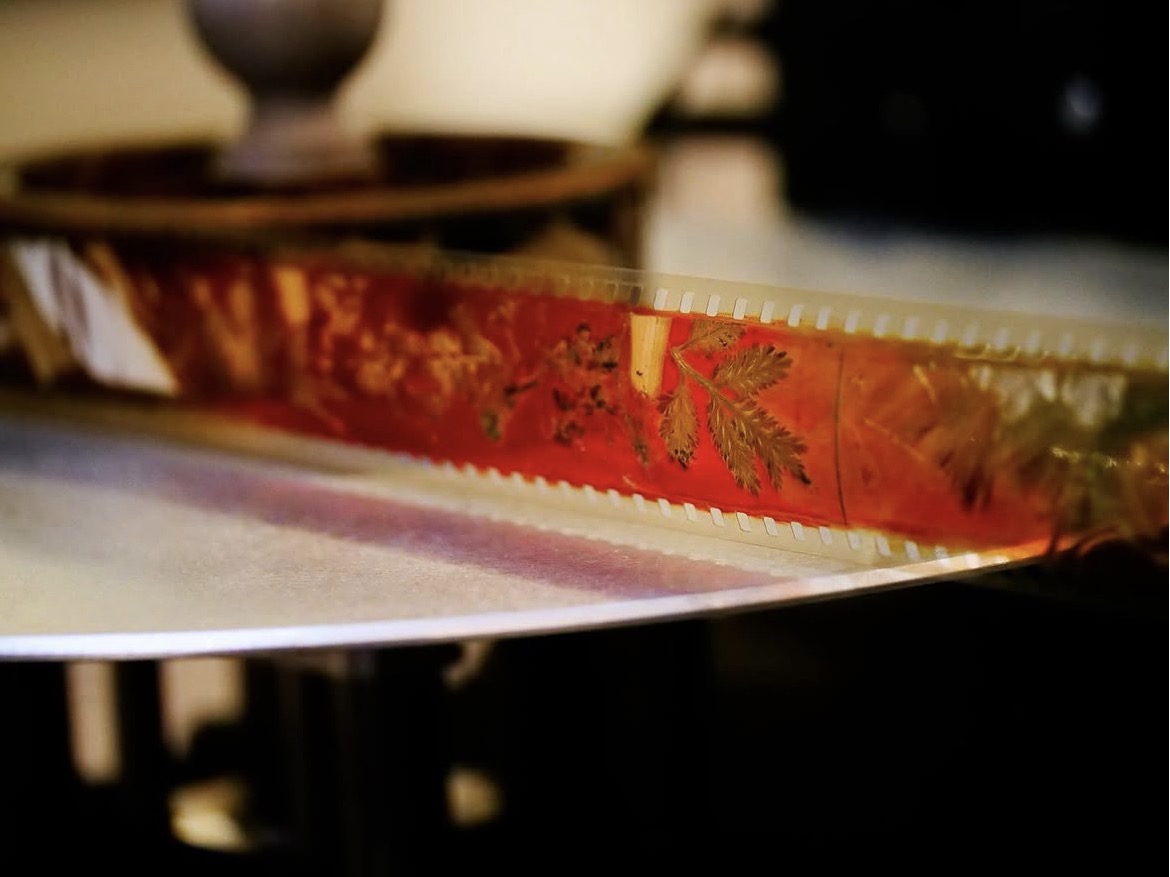
Scanning a hand-painted experimental film on Scan2Screen’s multispectral scanner. Ursula Heller, Lukas Kleine Weltmaschine.
Margaux Chalançon
Audiovisual Archivist, Film Atlas, which is convened by James Layton and supported by FIAF and George Eastman Museum
Presentation: Film Atlas: An International Encyclopedia of Motion Picture Colour
Film Atlas is a comprehensive online resource documenting the history of film as a physical medium. It encompasses moving image colour processes, sound systems, film formats and 3-D. This presentation will focus on how the website has been designed and structured to allow users to explore and study the unique and varied physical characteristics of different colour film stocks through annotation and comparison tools. Numerous entry points have been developed to support discovery and browsability. The website offers a global perspective that highlights the migration of technologies and ideas over time and across borders. Film Atlas is constantly growing with new essays published monthly. This presentation will showcase several forthcoming essays on colour film stocks and share some of the challenges of attempting to create a comprehensive resource on a global scale.
Margaux Chalançon is an independent audiovisual archivist. A graduate of the Film Preservation Master’s program at Elías Querejeta Zine Eskola (EQZE), Donostia-San Sebastian, she carried out the restoration of The Freedom Giver (Kais al Zubaidi, 1989). She currently works as production associate on the Film Atlas project and as an audiovisual archivist with Les Films de Mon Oncle, preserving the works of Jacques Tati.
Dr Kerstin Schroedinger
Uniarts Helsinki’s Academy of Fine Arts
Presentation: Autochrome Witnesses in the Industries of Denial
This paper reflects on the archival imagery that we – Angela Melitopoulos and Kerstin Schroedinger – seek to resurface and reconstruct through a mnemonic structure in our artistic research project Industries of Denial. Infrastructural photography (by the railway engineers, the military, the archaeologists) and the ‘Archive of the Planet’ set into motion a vibrant archive, the construction of a mnemonic structure, which we intend to resurface. We are re-searching and rephotographing digitised photographic collections of infrastructural photographs produced in the early twentieth century by railway engineers, military personnel, archaeologists, and ethnographers, particularly the Archives de la Planète, as it aimed to document a ‘vanishing world’ of multi-ethnic societies in Western Asia. In a way, it is a process of letting archival photographs of infrastructure building in Western Asia resurface into the present moment, to let them become tools to oppose the institutionalized, dominant narrative; to dismantle the enabling structures of denialism. Within this collection of archival photographs, the Archives de la Planète autochromes take up a certain task of ‘actualisation’, bringing the denied memory of the genocides in the Ottoman Empire and Turkish Republic into the present to project into the past.
Kerstin Schroedinger works on long-term, research-based projects at the intersection of film, sound, and performance, engaging with the social and political formations of time-based media through their historicity and materiality. She is currently a University Researcher at the Academy of Fine Arts Helsinki. Schroedinger’s works have been screened and exhibited across the world, including at CIC Cairo, Whitney Museum of American Art New York, 17th Istanbul Biennial, 2nd Kyiv Biennial, and have been featured at international film festivals in Berlin, Hong Kong, and Toronto, among many others.
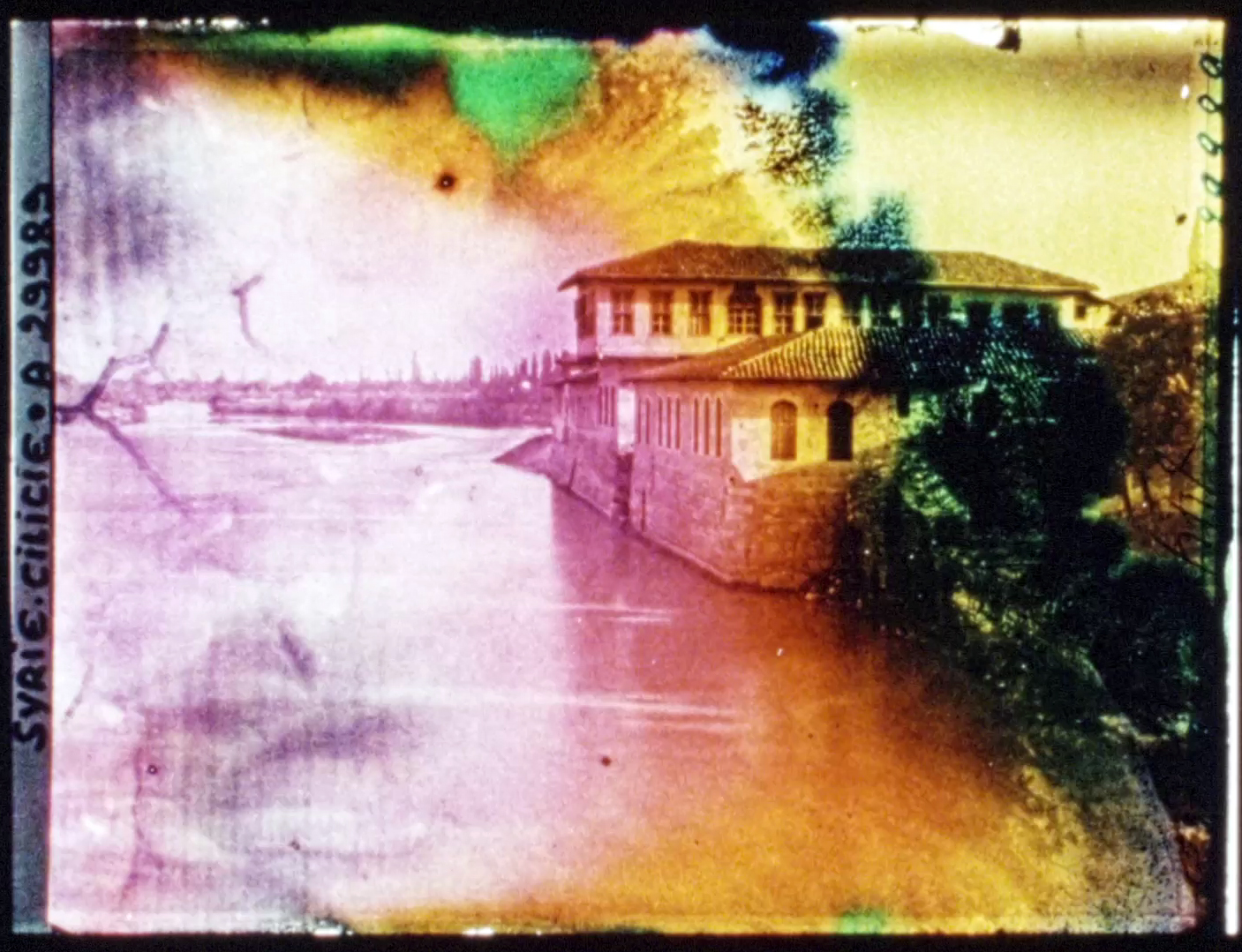
Industries of Denial, Stage 9: The Surface Zero of History, film still using original photograph by Frédéric Gadmer from 1921 (Albert Kahn Museum Collection), courtesy Angela Melitopoulos/Kerstin Schroedinger.
Dr Alexandra Loske FSA
Curator of the Royal Pavilion, Brighton & Hove Museums
Presentation: Colour matters at Brighton & Hove Museums: Curating colour at the Royal Pavilion and other museums
Dr Alexandra Loske has curated and contributed to several exhibitions on colour at the Royal Pavilion and Brighton Museum & Art Gallery, beginning in 2013 with Regency Colour and Beyond. Her largest exhibition to date was an immersive colour trail with an extensive events programme in the Pavilion in 2025, and her most recent one was Into the Blue in Brighton Museum and Art Gallery (2026), which drew from the prints and drawings collections of Brighton & Hove Museums. In this talk she will provide an overview of her various curating projects, highlighting the challenges that come with exhibiting colour in one of the most colourful of historic buildings in Britain, and the need to convey complex content in an accessible style.
Dr Alexandra Loske FSA is a British-German art historian, writer, and museum curator. The subject of her doctoral thesis was the use of colour in the Royal Pavilion, Brighton, where she is now curator. She has a particular interest in the role of women in colour history and is currently working on a major book about it. This is supported by the Centre for Life History and Life Writing Research at the University of Sussex, where she is Associate Director. Alexandra has curated many temporary art exhibitions, permanent displays, and smaller displays, among them Regency Colour and Beyond 1785–1845 (2013) at the Royal Pavilion. She was involved with the exhibition Turner et la Couleur in Aix-en-Provence, France, and the Turner Contemporary in Margate (2016/17). Most recently, she has curated COLOUR, an immersive exhibition and trail at the Royal Pavilion, Brighton (2025) and Into the Blue (Brighton Museum, 2026). The 2025 COLOUR exhibition coincided with the publication of her book The Royal Pavilion: A Regency Palace of Colour and Sensation (Yale University Press).
Alexandra has lectured, published, and broadcast widely on the history of colour, including for the National Gallery, London. In 2024 she published the comprehensive The Book of Colour Concepts with TASCHEN, followed by The Artist’s Palette (Thames & Hudson). She serves on the board of the Deutsches Farbenzentrum (German Colour Centre), is a member of The Colour Group GB, a fellow of the Society of Antiquaries of London, and a visiting research fellow at the V&A Museum.
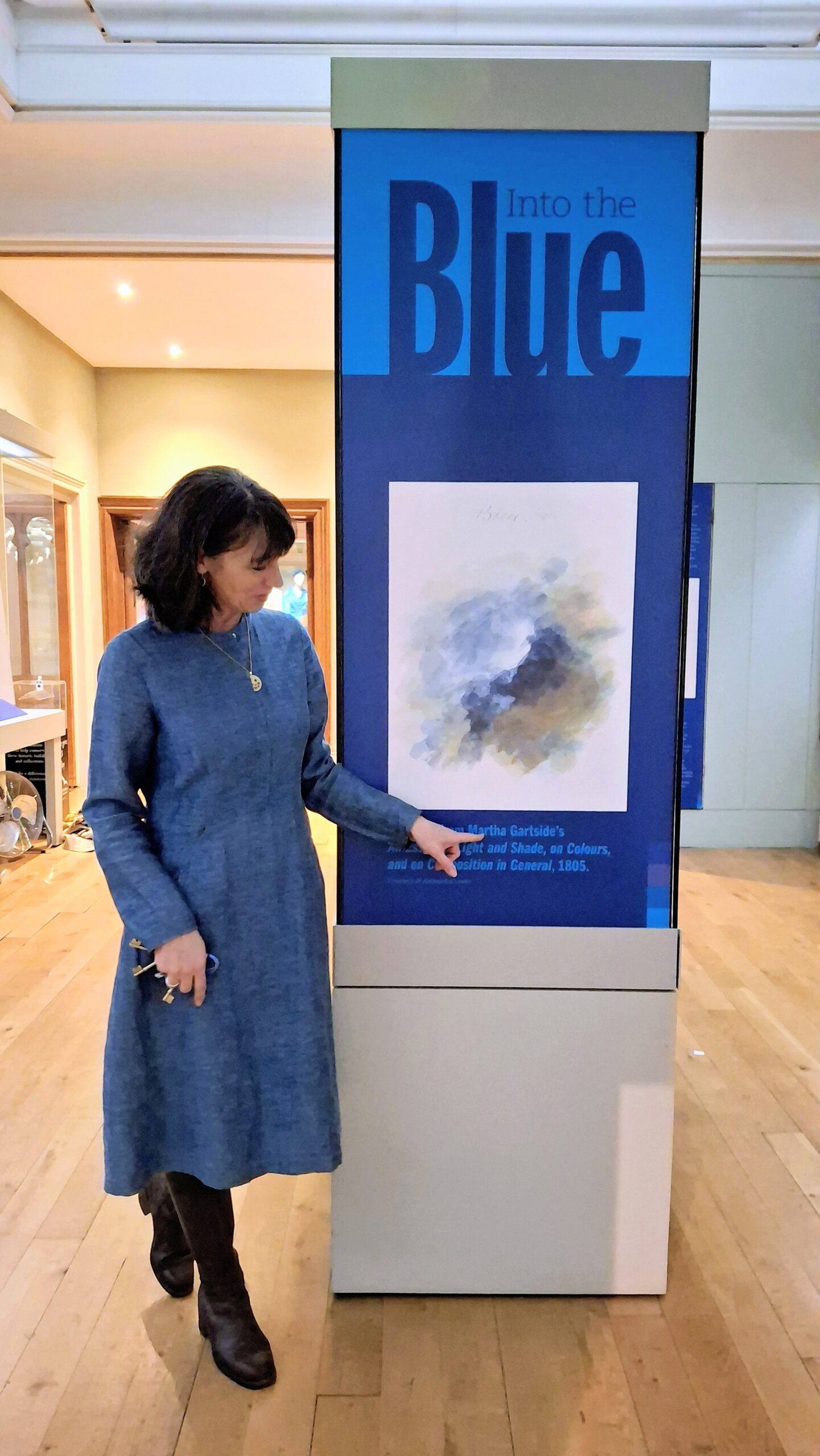
Alexandra Loske in her exhibition Into the Blue, Brighton Museum & Art Gallery, 2026.
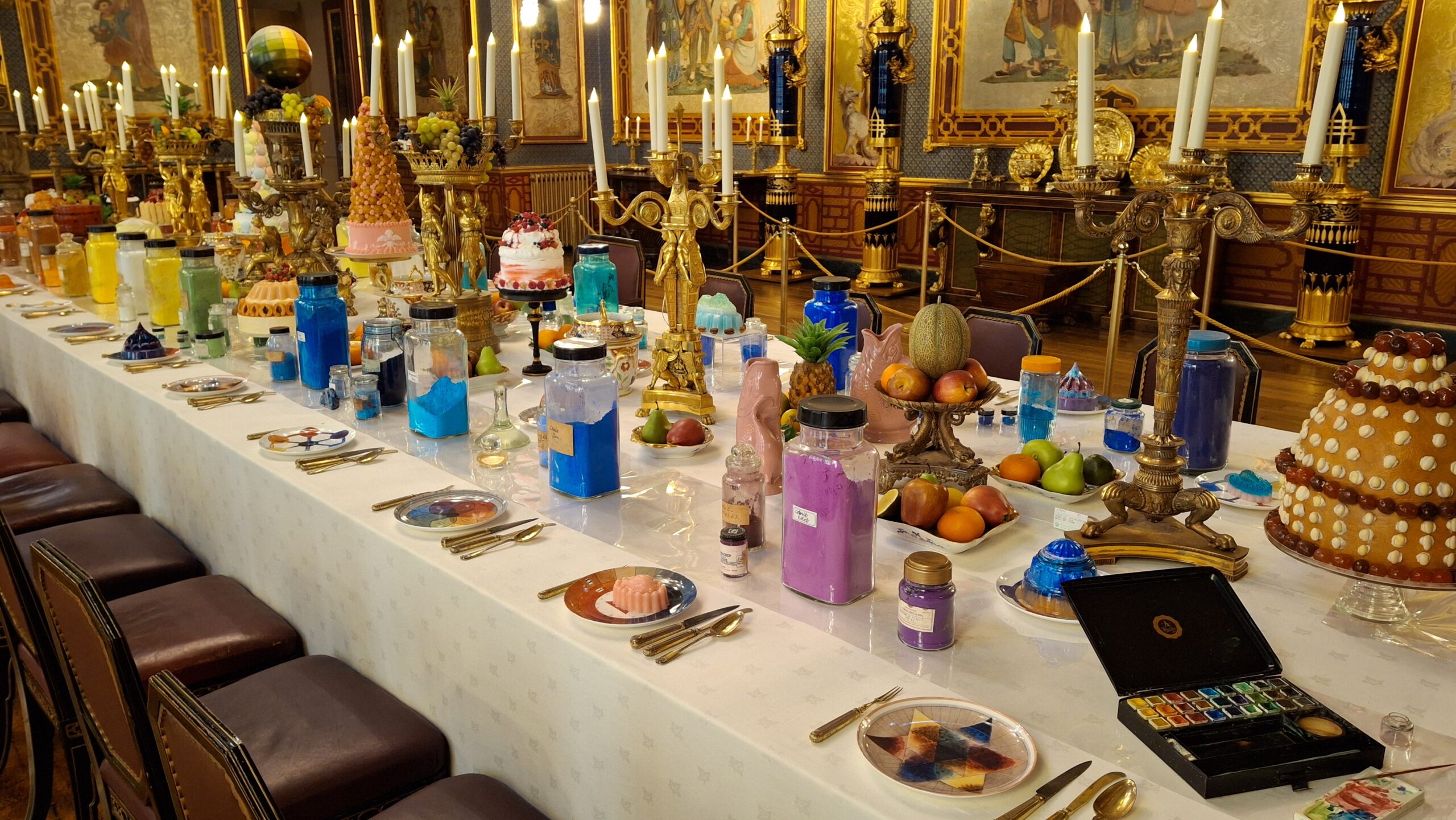
COLOUR, Banqueting Room, Royal Pavilion, 2025.